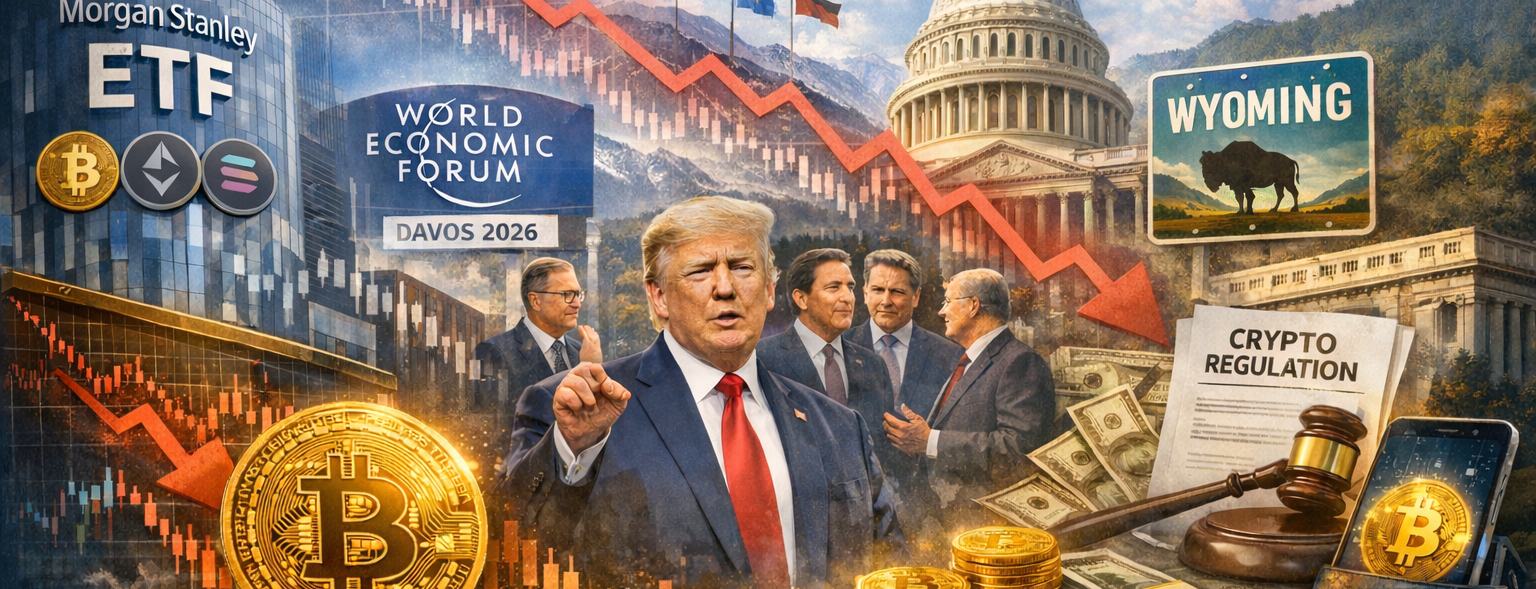
This monthly review looks at the most important cryptocurrency-related news from January. The key crypto news of the month focused on Morgan Stanley’s progress in the crypto markets, positive statements about cryptocurrencies at the World Economic Forum, advances in the crypto market in the United States, and Strategy’s continued bitcoin purchases.
              January in the cryptocurrency markets
Cryptocurrency prices declined in January and most large market-cap cryptocurrencies fell by at least ten percent during the month. The price of Bitcoin fell by 10 percent, while the price of Ethereum dropped by around 18 percent. There was significant macroeconomic uncertainty, which was reflected not only in cryptocurrency prices but also in relatively high volatility in assets such as gold and stock markets.
Morgan Stanley makes significant progress in the crypto markets
In January, two major crypto-related news items emerged from Morgan Stanley, one of the largest banks in the United States. First, it was revealed that the bank had filed ETF applications for Bitcoin, Ethereum, and Solana in the United States. According to ETF analyst Bryan Armour, Morgan Stanley’s decision to enter the crypto ETF market increases the legitimacy of cryptocurrencies, and other banks may soon follow its example.
Shortly after the ETF news, it also became known that Morgan Stanley plans to launch its own cryptocurrency wallet later this year. In addition to cryptocurrencies, the wallet will support tokenized real-world assets (Real World Assets, RWA), meaning assets brought onto the blockchain in token form, including stocks, bonds, and real estate. According to comments from Morgan Stanley, this is an example of a broader transformation in financial services infrastructure.
Several positive crypto statements at the World Economic Forum
At the World Economic Forum held in Davos, Switzerland, which brings together leading global politicians and business leaders, several positive statements regarding cryptocurrencies were heard in January. The most widely noted speech of the event, given by U.S. President Donald Trump, included positive comments about cryptocurrencies. Trump stated that he would ensure the United States remains the world’s crypto capital. He also said he expects to sign legislation supporting the cryptocurrency sector in the U.S. According to Trump, this new legislation will open up new opportunities for achieving financial freedom.
In addition to politicians, positive statements also came from the traditional financial sector. UBS Group CEO Sergio Ermotti spoke very positively in Davos about blockchain technology, which underpins cryptocurrencies. According to Ermotti’s bold statement, blockchain technology will be the future of traditional banking. Another notable comment came from Larry Fink, CEO of the world’s largest asset manager, BlackRock. According to Fink, it is necessary to update the financial system to operate on blockchain technology, as this would reduce costs and support the democratization of the system.
The United States moves forward in the crypto markets
In January, interesting crypto-related news emerged from the United States at both the state and federal levels. At the beginning of the month, the state of Wyoming in the western U.S. launched its own FRNT (Frontier Stable Token) stablecoin, making it the first U.S. state to issue a dollar-pegged stablecoin. FRNT operates on the Solana network, which was chosen for its fast and low-cost transactions. FRNT is overcollateralized, meaning that there are more assets backing the tokens than the value of the tokens themselves, and the assets are held by U.S. asset manager Franklin Templeton. In practice, the assets backing the stablecoin are invested in U.S. dollars and short-term U.S. government bonds.
In mid-January, a long-awaited federal-level crypto market structure bill was also unveiled in the United States. If approved, the bill would create a regulatory framework for cryptocurrencies and clarify the authority of financial regulators in the crypto sector. In practice, passing the bill would also define when cryptocurrencies are considered securities, commodities, or something else. The proposal received a mixed reaction in the crypto markets, and for example, Coinbase CEO Brian Armstrong commented on the bill in a very critical tone. Armstrong specifically criticized the proposed ban on stablecoin fees promoted by U.S. banks.
Strategy increased its bitcoin purchases and gained support from Vanguard
In January, the U.S.-based company Strategy made four bitcoin purchases, with a new purchase announced each week of the month. In total, Strategy bought 40,151 bitcoins during January for approximately USD 3.76 billion (EUR 3.18 billion). Following these purchases, Strategy’s holdings rose to 712,647 bitcoins, valued at around USD 56 billion (EUR 47 billion) at the end of the month. After the January purchases, the average purchase price of Strategy’s bitcoins is approximately USD 76,000 (EUR 64,300).
In addition, positive news related to Strategy emerged from the traditional investment world in January. The world’s second-largest asset manager, Vanguard, announced that it had purchased approximately USD 680 million (EUR 580 million) worth of Strategy’s MSTR shares for two of its ETF funds.
Summary
January was a challenging month for cryptocurrency prices. The prices of the largest cryptocurrencies declined clearly, and especially the price drops in Bitcoin and Ethereum reflected investors’ general caution. This was driven by broader global economic uncertainty, which was also visible in strong price movements in stock and commodity markets.
Despite falling prices, several positive developments for the crypto market emerged in January. Morgan Stanley’s decision to apply for crypto-related exchange-traded products and its plan to launch its own crypto wallet signal growing interest in the crypto sector from traditional banks. Particularly significant is the fact that the upcoming wallet will support traditional investment assets on the blockchain, which could attract entirely new investors to blockchain technology and cryptocurrencies.
In January, positive statements related to cryptocurrencies were also heard from international policymakers and major financial institutions. At the World Economic Forum, the potential of blockchain technology in developing the financial system was repeatedly highlighted. These comments reinforce the view that cryptocurrencies and the blockchain technology behind them are increasingly becoming part of the traditional financial sector.
In the United States, the crypto market moved forward in January at both the federal and state levels. Wyoming’s launch of a dollar-pegged digital currency can be seen as a significant initiative from the perspective of U.S. states. At the same time, the crypto market bill introduced at the federal level aims to clarify cryptocurrency regulation in the U.S., which is likely a step toward a more stable market.
Institutional interest was also visible in January through concrete investments. Once again, the most attention was drawn to the U.S.-based company Strategy, which continued its bitcoin purchases throughout the month, while the large asset manager Vanguard increased its holdings of Strategy’s MSTR shares in its funds. This suggests that many large players view Bitcoin as a potential investment despite short-term price fluctuations.
Overall, January illustrated the dual nature of the crypto markets. In the short term, prices have been under pressure, but at the same time, ongoing developments in the background are strengthening the position of cryptocurrencies and blockchain technology over the longer term.

Ville Viitaharju
Cryptocurrency specialist
Last updated: 06.02.2026 13:00