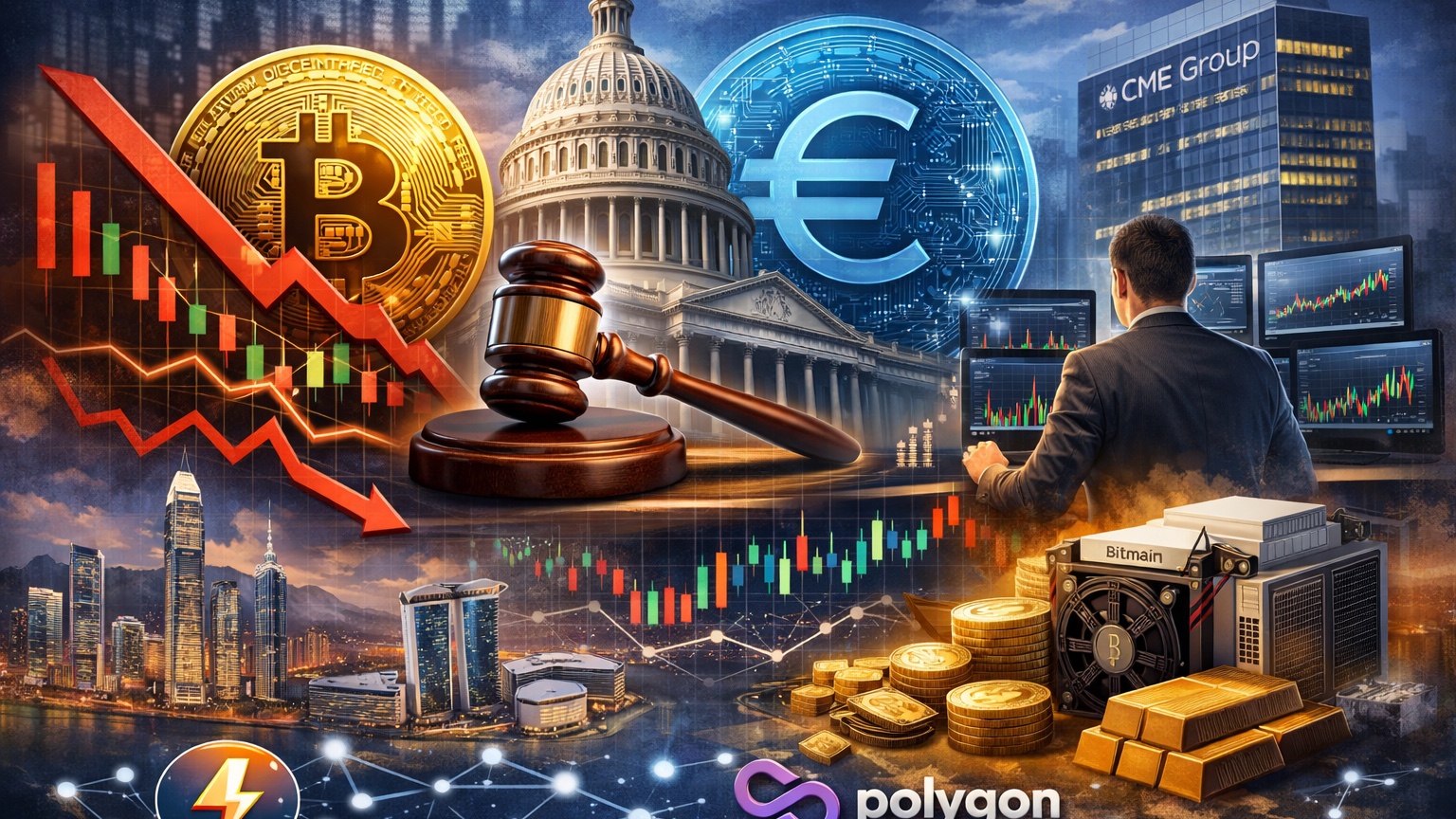
This monthly review examines the most important cryptocurrency-related news from February. The key crypto news in February included weak price performance in the cryptocurrency markets, a shift in direction by the SEC and the conclusion of several lawsuits in the United States, progress on the digital euro in Europe, the expansion of CME’s crypto derivatives trading, and cryptocurrency purchases by Strategy and Bitmine.
              February in the Cryptocurrency Markets
Cryptocurrency prices declined noticeably in February. Most cryptocurrencies with larger market capitalizations ended the month in negative territory, and the market experienced several strong waves of selling. The price of Bitcoin fell by around 10 percent during February and was trading at roughly $65,000 at the end of the month. Ethereum declined by approximately 15 percent, with the price falling below $2,000. The price decline was influenced by macroeconomic uncertainty, particularly expectations related to interest rate policy and the outlook for the U.S. economy. Risk assets, including cryptocurrencies, tend to react sensitively to changes in interest rate expectations. Equity markets also experienced volatility, and overall market volatility remained elevated throughout the month.
February demonstrated that the crypto market remains strongly tied to the global macroeconomic environment. Although the market did not experience a broad deterioration in liquidity, investors’ risk appetite clearly weakened during the month. This was particularly visible in altcoins, which saw steeper declines than Bitcoin.
SEC Ends Several Major Crypto Lawsuits
Under the leadership of Paul Atkins, the U.S. Securities and Exchange Commission (SEC) has made a significant shift in its approach to crypto regulation. During February, several major legal cases were either dropped, settled, or no longer actively pursued.
For example, the SEC ended its legal process against the U.S.-based crypto exchange Coinbase and paused investigations related to the activities of Kraken and Consensys (MetaMask). In addition, the agency abandoned several investigative tracks targeting the DeFi sector, including those directed at decentralized trading platforms.
This represents a clear change in direction compared to the previous “regulation by enforcement” approach, where the SEC attempted to define the rules for the crypto sector primarily through legal action. The suspension of several cases suggests that the commission intends to move toward a clearer and more predictable regulatory framework for cryptocurrency legislation.
The shift is a significant relief for the broader crypto sector. Reduced legal risks lower uncertainty, particularly for U.S. exchanges, token issuers, and DeFi projects. At the same time, it improves the competitiveness of the United States relative to Europe and Asia, where the regulatory environment has been clearer in recent years. Many analysts consider this one of the most important regulatory developments of 2026 so far.
Digital Euro
One of the most significant crypto-adjacent developments in February came from Europe. The European Parliament advanced the digital euro process by supporting a model in which the central bank digital currency would function both online and offline.
The goal of the digital euro is to complement cash, improve payment accessibility across the euro area, and strengthen the EU’s strategic autonomy in payment systems. The initiative is also driven by concerns about reliance on U.S.-based payment networks and private stablecoin solutions.
The project will proceed gradually through the legislative process, and any pilot program would likely take place at a later stage. Nevertheless, the decision indicates that central bank digital currencies are moving from conceptual discussions toward concrete preparation, particularly in Europe. At the same time, it is expected to accelerate innovation in the private payments sector.
CME Expands Crypto Derivatives Trading
CME Group, the world’s leading derivatives exchange, announced plans in February to expand cryptocurrency derivatives trading to operate around the clock. The change still requires regulatory approval, but it reflects growing demand for crypto derivatives, particularly among institutional investors.
According to CME, the average daily trading volume of its crypto products has increased significantly over the past year. At the same time, open interest has risen, indicating stronger long-term market participation rather than purely short-term speculation.
The growth of derivatives markets reflects the maturation of the crypto market. Futures and options enable more efficient risk management, arbitrage opportunities, and market-neutral trading strategies. This development strengthens the integration of cryptocurrency markets into the broader traditional financial system.
Asian Markets and International Developments
In Asia, cryptocurrency trading volumes increased in February, and several exchanges in the region reported higher user activity. Hong Kong and Singapore continued to strengthen their positions as crypto hubs by offering clear and business-friendly regulatory frameworks.
Hong Kong’s licensing regime has attracted international firms to establish local operations, while Singapore focuses particularly on institutional services and the development of blockchain infrastructure. Global competition for crypto companies is intensifying, and Asia is seeking to leverage regulatory clarity as a competitive advantage.
In addition, several Asian financial institutions announced experiments involving the tokenization of securities using blockchain technology. For example, Hong Kong Financial Secretary Paul Chan announced on February 25 the development of a new digital platform for issuing and settling tokenized bonds. The platform aims to integrate tokenized securities into traditional capital markets.
Lightning Network and Polygon Made Headlines
The monthly transaction volume of Bitcoin’s Lightning Network exceeded $1 billion in February. This represents a significant milestone for Bitcoin’s layer-2 solution and demonstrates that payment infrastructure built on top of the main network is developing in practical use.
The growth of the Lightning Network suggests that Bitcoin is not only functioning as a store of value but is also increasingly supporting payment solutions built on top of it. Micropayments and small international transfers are particularly well suited to the Lightning Network.
February also saw developments in the transaction activity of Ethereum layer-2 solutions, as Polygon’s daily transaction fees briefly surpassed those of Ethereum. This was largely driven by the strong popularity of the prediction market Polymarket. The growth of prediction markets illustrates how decentralized applications can rapidly generate significant network activity and increase the prominence of individual networks in a short period of time.
Strategy Increased Its Bitcoin Holdings
Strategy (formerly MicroStrategy) continued its active Bitcoin accumulation in February 2026 through several separate purchases. During the month, the company acquired approximately 5,075 bitcoins across four transactions.
At the beginning of February, Strategy purchased 855 bitcoins for roughly $75 million. This was followed by another purchase of 1,142 bitcoins worth approximately $90 million. In mid-February, the company acquired 2,486 bitcoins for around $168 million, and at the end of the month it purchased an additional 592 bitcoins for approximately $39.8 million.
Following the February purchases, Strategy’s total holdings rose to approximately 717,722 bitcoins, acquired at a total cost of about $54.56 billion. The company was effectively the only major publicly listed firm that increased its bitcoin holdings during the month, highlighting its unique position in the market.
Bitmine Continued Ethereum Purchases
February also saw unusually strong institutional accumulation of Ethereum, particularly from Bitmine (NYSE: BMNR), which significantly increased its ETH holdings as part of its treasury strategy.
During the month, the company acquired 51,162 ether, bringing its total holdings to more than 4.42 million ether. This represents approximately 3.66 percent of Ethereum’s circulating supply, with the holdings valued at roughly $8.7 billion at February price levels.
A significant portion of Bitmine’s ether holdings is staked, generating an estimated annual staking yield of more than $170 million. This makes the Ethereum treasury strategy not only dependent on price appreciation but also a source of recurring cash flow. The company’s goal is to increase its holdings to five percent of the total ETH supply if market conditions allow.
Summary
In terms of price performance, February was a challenging month for the crypto markets. The prices of the largest cryptocurrencies declined and volatility remained high, reflecting macroeconomic uncertainty and weaker investor risk appetite. Despite the price pressure, several structurally important developments took place during the month that could strengthen the market over the longer term.
In the United States, the SEC made a significant shift in crypto regulation by ending several major lawsuits. This departure from the previous “regulation by enforcement” approach reduces legal uncertainty and creates room for clearer legislation. The development is widely regarded as one of the most important regulatory advancements of 2026, as it improves the competitiveness of the United States relative to Europe and Asia.
In Europe, regulatory progress continued regarding the digital euro, as the European Parliament supported a model in which the central bank digital currency would function both online and offline. The initiative aims to strengthen payment systems and increase the EU’s strategic autonomy while also demonstrating that central bank digital currencies are moving toward more concrete development stages.
On the institutional side, CME Group announced plans to expand crypto derivatives trading to operate around the clock. Growing derivatives volumes and rising open interest indicate market maturation and the increasing use of cryptocurrencies as tools for risk management and investment strategies.
In Asia, trading volumes increased while Hong Kong and Singapore strengthened their roles as crypto hubs through clear regulatory frameworks. At the same time, the development of tokenized real-world assets (RWA) and blockchain-based experiments emerged as an important long-term growth trend.
On the technological front, Bitcoin’s Lightning Network monthly volume exceeded $1 billion, highlighting the continued development of Bitcoin’s layer-2 payment infrastructure. In addition, Polygon briefly surpassed Ethereum in daily transaction fees due to increased activity in prediction markets, demonstrating the impact that decentralized applications can have on network dynamics.
During February, Strategy continued its aggressive bitcoin accumulation and accounted for nearly all bitcoin purchases by publicly listed companies during the month. At the same time, Bitmine significantly increased its Ethereum holdings and continued implementing a treasury strategy based on staking yields.
Overall, February was weak in terms of price performance but structurally strong for the crypto market. Increasing regulatory clarity, institutional participation, and infrastructure development suggest that the market continues to mature despite short-term price pressure.

Mikko Soon
Last updated: 06.03.2026 13:00