Blog: Digital Euro vs. Traditional Stablecoins – Competition, Criticism, and the Future
Blockchain Monetary policy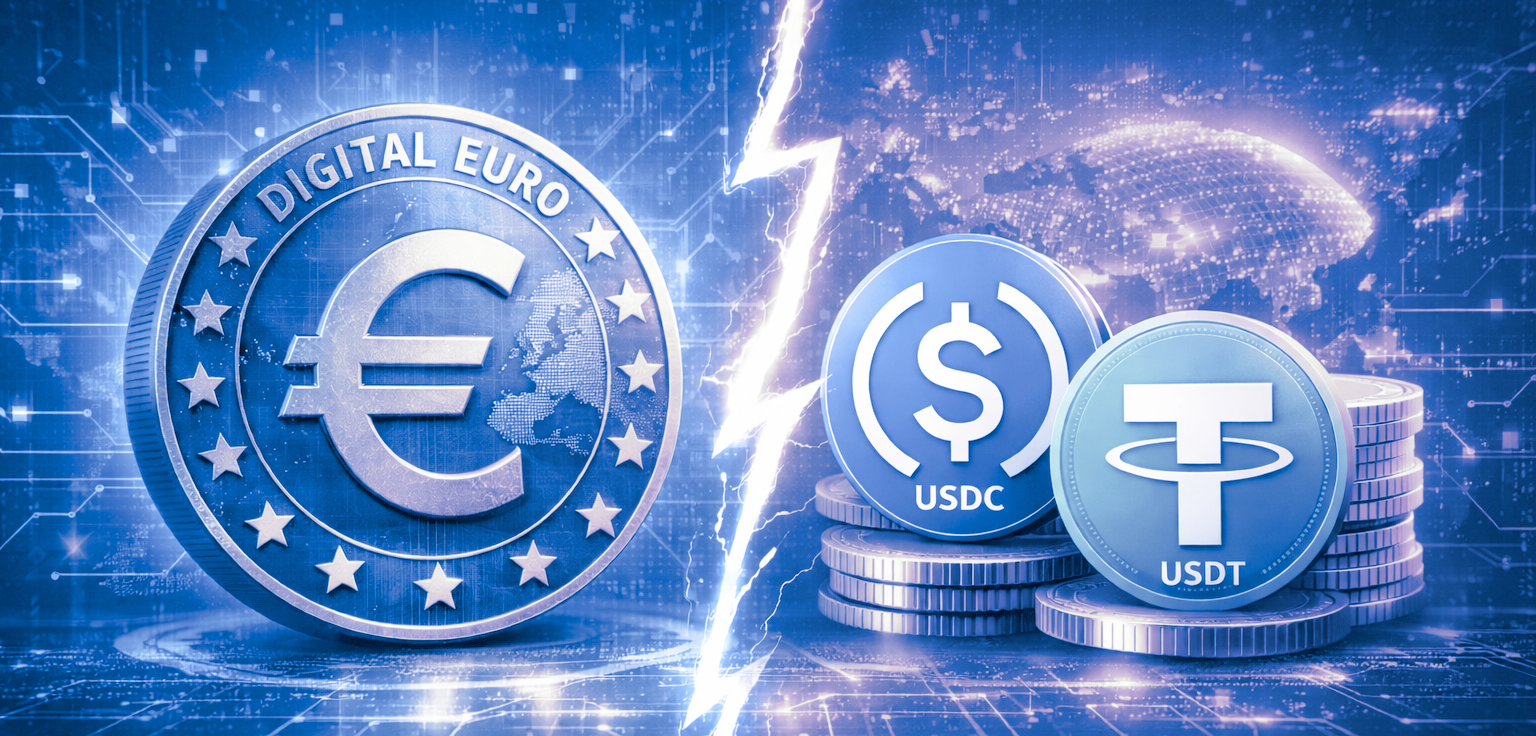
Digital money has moved to the core of economic policy and power. The digital euro and traditional stablecoins represent two different monetary models. This blog post explores how they differ and what implications they may have for the future of money.
Money, Power, and Trust in the Digital Economy
Digital money is no longer an experiment, but part of a global power struggle over money and payment systems. Central banks are rapidly developing their own digital currencies (CBDCs), and within the euro area particular attention is focused on the digital euro. At the same time, traditional stablecoins such as USDC have already established themselves as core infrastructure for crypto markets and decentralized finance.
The discussion is often framed as a simple confrontation: the digital euro versus stablecoins. This framing, however, obscures the essential question. The issue is not merely about payment methods or technical implementation, but about how the fundamental structure of money will evolve in the future, who exercises power over monetary flows, and how well individual freedom is preserved in the digital economy.
The Digital Euro and Stablecoins – Two Different Monetary Models
The digital euro is a form of digital money issued by a central bank and represents a direct claim on the central bank, without counterparty risk related to a private issuer. According to the European Central Bank, the objective of the digital euro is to provide the public with a safe and widely accepted means of payment in an increasingly digital economy.
This structure clearly distinguishes the digital euro from, for example, euros held in a personal bank account. A bank deposit is a liability of a commercial bank to its customer, whereas a digital euro would be a direct claim on the central bank. The difference is reflected in the risk profile, payment structure, and oversight: the digital euro would enable payments directly in central bank money without the traditional interbank settlement chain, while at the same time concentrating payment infrastructure and the associated power. This is not merely a technical change, but a question of how money functions in the digital economy and who ultimately controls it.
Stablecoins, by contrast, are digital tokens issued by private entities whose value is intended to remain stable relative to an underlying fiat currency, such as the euro or the U.S. dollar. Stability is usually based on reserves, but practices vary significantly from one project to another.
The difference is not only legal, but also philosophical. The digital euro represents public money issued by a central bank, where trust is based on institutions and legislation. Stablecoins, on the other hand, represent market-driven money, where trust emerges from contracts, transparency, and competition among issuers.
This fundamental difference also determines the types of risks and opportunities each model entails.
The Strength of Stablecoins: Global, Open, and Programmable Money
The rapid adoption of stablecoins is no coincidence, but rather the result of their ability to solve several structural problems in the financial system, particularly in digital and cross-border environments. Stablecoins enable global value transfers without traditional intermediaries, operate around the clock without banking hours, and integrate directly into blockchain-based applications. This allows money to move in real time and become part of digital services in ways that the traditional banking system has struggled to support.
A key difference compared to traditional payment instruments is the programmability of stablecoins. A stablecoin is not merely a digital representation of money, but a foundational component of digital services that can be used in smart contracts, automated payments, and complex financial structures. For this reason, decentralized finance (DeFi) and the tokenization of real-world assets (RWA) have, in practice, been built on stablecoins. They serve as a common denominator that enables the transfer, locking, and settlement of value within blockchain environments.
The most significant weakness of stablecoins relates to counterparty risk. Users must trust that the issuer maintains sufficient and high-quality reserves, operates transparently, and complies with applicable regulation. The European MiCA framework seeks to reduce this risk by imposing stricter requirements on stablecoins, while at the same time steering the market toward larger and more heavily regulated players.
Stablecoins have established themselves as a core component of the digital economy, and their development suggests that they will continue to play a central role in the infrastructure of global payments and digital financial services.
The Strength of the Digital Euro: Stability and Trust
The key strength of the digital euro lies in its status as money issued by a central bank. Users do not need to assess the issuer’s creditworthiness or the quality of reserves, as the digital euro is a direct claim on the central bank. This makes it, in principle, a more stable and predictable form of money than digital payment instruments issued by private entities.
However, the same structure that provides stability also raises questions. From the perspective of central banks, the digital euro is a tool to strengthen the stability of the payment system, preserve the functioning of the monetary system, and offer an alternative to increasingly concentrated private payment systems. At the same time, it centralizes key payment infrastructure under a public authority and alters the role of banks as intermediaries of money.
The digital euro is therefore not merely a technical upgrade to existing payment methods, but a structural change to the monetary system. It affects who controls payment flows, how money circulates in the economy, and what kind of relationship individuals have with the public monetary system in a digital environment. These broader implications make the digital euro not only an economic issue, but also a societal one.
Privacy – The Most Central and Controversial Question
One of the most serious concerns related to the digital euro is the potential erosion of privacy. Digital money technically enables detailed and centralized record-keeping of all payment transactions, making monetary flows more transparent than before from the perspective of authorities and system operators. While payment data is already subject to regulation and oversight today, the digital euro could significantly expand the scope for centralized visibility and control.
Central banks and lawmakers have repeatedly emphasized that the digital euro is not intended as a surveillance tool or a means to monitor individuals’ spending. Criticism, however, is directed less at current intentions and more at the structure itself. A system that technically enables comprehensive monitoring inevitably creates a political risk: rules can be changed, exceptions expanded, and use cases stretched in the future. Historically, many surveillance mechanisms have emerged under the guise of crisis response and remained permanent features of the system.
The privacy question surrounding the digital euro is not only about who can see transactions, but also about who decides the conditions of payment. Digital infrastructure enables the freezing, restricting, or targeting of payments in ways that were not previously as technically straightforward. Even if such functions are not intended for normal circumstances, their existence shifts the balance of power within the monetary system.
Current digital payment methods are based on a decentralized banking system, where payment data and visibility are distributed across multiple actors. The digital euro would change this arrangement by relying on a more centralized infrastructure, where transaction records and rule enforcement fall within a single system. Although the design of the digital euro emphasizes privacy considerations and limited offline functionality, a digital system inevitably requires some degree of identification, rule compliance, and oversight. As a result, the digital euro cannot offer the same level of decentralized privacy as the current multi-actor payment system; instead, privacy would exist within predefined structural boundaries.
Ultimately, privacy is not only a technical issue but one of trust in institutions and political decision-making. The acceptability of the digital euro will largely depend on whether citizens perceive the rules of the payment system as predictable, limited, and stable over time. The issue is not only what the system does today, but what kinds of powers it enables in the long run and who ultimately decides how they are used.
Usage Restrictions and the “Programmable Money” Debate
Another major criticism directed at the digital euro concerns usage conditions and the so-called programmable money debate. The European Central Bank and EU policymakers have repeatedly emphasized that the digital euro is not intended to be implemented as money that can only be used for predefined purposes. Nevertheless, digital infrastructure technically enables the restriction, targeting, or conditioning of money in ways that were not previously possible within traditional payment systems.
The concern is less about current plans and more about the precedent such a system would create. Once the monetary infrastructure includes the technical ability to impose usage conditions, future governments or exceptional circumstances may expand these powers. Economic crises, security concerns, or climate policy could provide justifications for steering money usage in ways not originally intended to be permanent.
The discussion often raises scenarios in which spending is guided by economic policy objectives, such as incentives or restrictions applied to specific types of consumption. There have also been concerns about the possibility of imposing negative interest rates directly on users’ digital holdings or blocking payments to certain industries, organizations, or individuals through administrative decisions. While such measures are not part of the digital euro’s current plans, their technical feasibility would fundamentally alter the nature of money.
It is also important to note that usage restrictions might not appear to users as explicit bans, but rather as subtler steering mechanisms, such as spending caps, time limits, or automated rules operating in the background. This is what makes the debate particularly challenging: restrictions could emerge gradually and as part of broader policy measures, without a single clear decision.
Stablecoins are not entirely free from similar risks, as issuers can also freeze funds or block transactions. However, their more decentralized structure and competition among different stablecoins limit the concentration of power in a single actor. Users typically retain the ability to switch to alternative solutions, which serves as a counterbalance to the expansion of usage restrictions.
Conclusion
The relationship between the digital euro and traditional stablecoins does not appear as a simple competition in which one wins and the other loses. Instead, it reflects two different ways of constructing a monetary system in the digital age. The digital euro aims to strengthen stability, uniformity, and public control over payments, but does so through centralized infrastructure and oversight. While this brings predictability, it also raises justified concerns about privacy, usage conditions, and the concentration of power.
Stablecoins, by contrast, have evolved through market-driven processes to meet the practical needs of the digital economy. Their strengths lie in openness, programmability, and seamless integration into blockchain environments where innovation happens rapidly. In return, users must accept counterparty risk and an evolving regulatory landscape. Stablecoins offer flexibility and freedom, but require greater understanding and responsibility from users.
Ultimately, the question is not only about technology or payment methods, but about values. How much centralized control are we willing to accept in the name of stability? How much freedom and choice do we want to preserve in the digital economy? The future of digital money will be shaped by these choices, which is why the debate around the digital euro and stablecoins is ultimately a debate about power, trust, and economic self-determination.
Mikko Soon
Head of Northcrypto Private
Last updated: 23.01.2026 13:00